

Thanh bên bài viết

 CC BY 4.0
Truy cập mở
CC BY 4.0
Truy cập mở
Được sao chép, phân phối lại và chỉnh sửa bài báo, với điều kiện:
-
Ghi nguồn tác giả và bài báo gốc
© 2026 Tạp chí Khoa học và Công nghệ Nhiệt đới
Results of Antifouling Coating Tests in Nha Trang Bay Using Wet Weight Measurements and Visual Method
Nội dung chính của bài viết
Tóm tắt
Data from marine field tests of epoxy-based anti-fouling coatings containing various biocidal additives are presented. Epoxy coatings free of highly toxic substances were used in the study. These coatings were exposed for two years in the sea at the "Dam Bay" marine research and testing station, located on Che Island in Nha Trang bay. Biofouling was classified to species, where possible. When species-level identification was not feasible, organisms were classified to higher taxonomic levels such as genus, family, class, or type. The number of individuals in each taxon was counted and the total biomass of all individuals of that taxon was measured. ImageJ software was applied to determine the biofouling area. Statistical analyses used included: ANOVA, with post-hoc pairwise comparisons of mean values using Fisher's LSD correction for multiple comparisons, PERMANOVA (using the Bray-Curtis similarity index with a prior logarithmic transformation of biomass data).The statistical significance of the influence of plate orientation and their arrangement on the cassettes on the intensity of marine fouling was assessed. This study demonstrated the advantage of the wet weight method over projective coverage analysis for evaluating environmentally friendly antifouling coatings after two years of exposure in a tropical marine environment, where area-based assessment is no longer effective. Epoxy coatings free of highly toxic substances were used in the study. of the wet weight method over projective coverage analysis for testing environmentally friendly antifouling coatings after two years of testing in a tropical climate, when assessment by fouling area is no longer effective.
Từ khóa
Biofouling biomass assessment, environmentally friendly antifouling coatings, long-term field exposure, silver nanoparticles (AgNPs), Tropical Marine biofouling community structure, wet weight (gravimetric) analysis
Chi tiết bài viết
Introduction
The history of combating marine fouling spans several centuries. The traditional approach to this problem involves the use of protective coatings containing biocidal agents that inhibit the settlement and growth of fouling organisms (Karpov et al., 2018; Chava & Mokievsky, 2002). However, the environmental and human health hazards associated with some highly effective biocides – such as organotin compounds (e.g., tributyltin), lead-based substances (including red lead), and others – have prompted a global trend towards the development and application of environmentally safe biocidal additives for anti-fouling coatings (Chava & Mokievsky, 2002; Abacharaev & Abacharaev, 2011; Kharchenko et al., 2024; Walter et al., 2024). In addition to understanding the mechanisms of biocide action when developing such coatings, it is essential to consider the compatibility of the formulated paints and organosilicate compositions for protective applications, as well as their ability to incorporate biocidal additives effectively.
The development of new protective coatings, especially those utilizing previously untested environmentally friendly biocides, requires prolonged iterative refinement of formulations – eliminating ineffective components and enhancing those demonstrating promising efficacy. Accurate assessment of the antifouling properties necessitates the use of precise analytical methods to characterize the fouling communities that develop on test samples. Conventional methods specified in GOST 9.412-2001 (Russian State Standard) often lack sufficient sensitivity, necessitating the adoption of quantitative evaluation techniques used in hydrobiology. Furthermore, a thorough interpretation of test results benefits greatly from knowledge of the typical succession of fouling communities in the specific aquatic environment where testing occurs. Such knowledge allows one to determine whether the development of biofouling communities is being disrupted by the tested biocides. Unfortunately, the succession patterns of fouling communities in the Dam Bay area of the south China sea remain insufficiently studied for confident predictive modeling (Karpov et al., 2018; Chi et al., 2022).
It is important to note that marine field-test coatings are periodically subjected to storm events, temporary water displacements, and other catastrophic influences, leading to the death and mechanical removal of fouling organisms from the test surfaces. This complicates the accurate prediction of the "shelf life" of protective coatings during long-term field testing (Mahmoud et al., 2021; Pecherkin et al., 2023; Smirnova, 2021). Consequently, the development of new, less time-consuming assessment techniques for evaluating antifouling properties remains an urgent and relevant challenge.
At the same time, environmentally friendly coatings develop fouling much faster. Therefore, the traditional method of assessing fouling by surface area is not always effective in long-term full-scale marine testing. In such cases, the most effective method for assessing marine fouling is wet weight measurement.
To illustrate the effectiveness of the gravimetric method for assessing the coatings antifouling activity, epoxy resin-based coatings were selected, which are traditionally used as both anticorrosive and antifouling ones (Anwar & Li, 2024; Makhmetova et al., 2024; Thomas et al., 2024). Epoxy coatings are also often used as experimental antifouling coatings to study the effect of new biocides on antifouling activity (Jaramillo et al., 2019; Szmechtyk et al., 2026). In this work, biocides (zinc and copper phosphates and zinc, copper and strontium chromates) combining antifouling and anticorrosive activity were used. These compounds are commonly used as corrosion inhibitors in paint coatings. Most often, researchers use zinc and copper compounds (oxides Cu2O and ZnO, organic complexes such as copper and zinc pyrithione, or salts of cuprous chloride and zinc sulfate) as biocides (Elia et al., 2022; Lenoble et al., 2026). Zinc and especially copper compounds, as well as hexavalent chromium compounds, are considered to be fairly harsh biocides in terms of their impact on the environment. Therefore, silver nanoparticles distributed on a porous carrier - aluminum hydroxide - were used as an alternative. Nanoparticles, including silver nanoparticles, are believed to be effective in combating biocorrosion and biofouling. There are examples of the use of silver nanoparticles coated with a silicon dioxide shell (Ag@SiO2) as an antifouling agent (Thomas et al., 2024). Silver effectively inhibits biocorrosion, while the silica shell retains and slowly releases silver, slowing down the initial corrosion processes and biofouling. In this study, we used silver nanoparticles deposited on aluminum hydroxide, which also has the property of gradually degrading in the marine environment.
The purpose of this study was to demonstrate the feasibility of using the gravimetric method (wet weight measurement) for testing environmentally friendly antifouling coatings after two years of testing in a tropical climate, when assessment by fouling area is no longer effective. The study utilized epoxy coatings that do not contain highly toxic substances.
Materials and Methods
Materials
The study involved coatings derived from epoxy resin-based (ER) formulations containing biocidal additives – metal phosphates and chromates, as well as an innovative biocide in the form of silver nanoparticles (AgNPs) applied onto a porous carrier (aluminum hydroxide) (Table 1).
Silver nanoparticles were formed on the surface of a support (aluminum hydroxide), which is environmentally safe and also functions as a flame retardant. Silver ions were reduced in situ on the aluminum hydroxide surface using hydrosilanes and hydrophobized by mixtures of oligohydridosiloxanes and nonionic surfactants. The concentration of colloidal silver distributed on the support was 0.15 wt. % (calculated as metallic silver).
Coatings were applied to glass-reinforced plastic (GRP) substrates conforming to GOST 12652 (Russian State Standard), measuring (15 × 35) cm, via pneumatic spray. For comparison, epoxy coatings without biocidal additives were prepared, and untreated glass-reinforced plastic plates served as controls. Each type of sample was represented by three plates. The number of replications was restricted by the technical capabilities of offshore test facilities. This number of specimens is standard for large-scale marine field exposure tests due to limitations in installation space, while acknowledging that this constraint may affect the sensitivity of statistical analyses.
Table 1. Description of antifouling epoxy coatings with various biocidal additives
Designation | Biocides | Photos of the coating surface |
GEV 1 | Without biocides |
|
GEV 2 | Zn3(PO4)2 and Cu3(PO4)2: 23.5 wt. % in the paint |
|
GEV 3 | ZnCrO₄ and CuCrO₄: 26.5 wt. % in the paint |
|
GEV 4 | SrCrO₄: 23.5 wt. % in the paint |  |
GEV 5 | Silver nanoparticles (AgNP) on Al(OH)3: 0.15 wt.%; Al(OH)3: 30 wt. % in the paint |
|
Control | Glass-reinforced epoxy laminate without coating |
|





Methods
Location, duration and methods of field testing
The experimental coatings underwent in situ testing at the Coastal Branch of the Joint Vietnam - Russia Tropical Science and Technology Research Center (Dam Bay, Nha Trang Bay). The exposure duration of the plates in the sea was two years, from December 2021 to December 2023.
The test plates were mounted and securely fixed on stainless steel cassettes, with six plates per cassette (Figure 1). The cassettes were consistently and rigidly positioned in the water in a submerged state and anchored to a raft located near Nha Trang Bay (Vietnam).
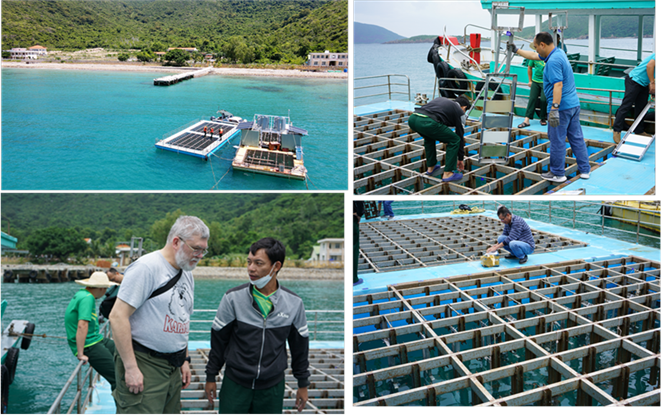
Figure 1. Installation of plates with experimental coatings at the Marine Research and Testing Station (MRTS) “Dam Bay,” located on the Island in Dam Bay Gulf (12°14' N, 109°11' E). Approximate distance from the sea: 100 meters
The plates had a front (exposed) and reverse side. Consequently, if one side of a plate was subjected to active hydrodynamic conditions, the opposite side was simultaneously in the hydrodynamic shadow. Additionally, the cassettes were oriented vertically within the water column. The plates on the cassettes were arranged one above the other, at varying depths (the distance between plates in cm, approximately 10 cm), ranging from 0.5 to 1.5 m. Neither the plates nor the cassettes made contact with the seabed. The exposure duration of the plates in the sea was two years, from December 2021 to December 2023.
Data Collection and Preliminary Processing
To assess the antifouling properties of the coatings, both visual (visual assessment of fouling of the coating surface) and gravimetric measurements of biofouling formed on the test plates were conducted. The procedure consisted of the following steps:
1. The cassette with plates was retrieved from the water, and photographic documentation of each plate was performed on both sides.
2. The plates were detached from the cassettes and transported to the laboratory.
3. In the laboratory, each plate was photographed again from the front and reverse sides to evaluate any incidental damage (e.g., detachment or loss of fouling) that could have occurred during detachment and transportation.
4. On the reverse side of each plate, all organisms (foulers) were removed with a metal spatula. After drying on filter paper, the total wet weight of fouling organisms was determined with an accuracy of up to 1 mg.
5. On the front side, organisms were similarly removed with a spatula. However, all collected organisms were sorted into different biological taxa. Whenever possible, each group was identified to the species level. When species-level identification was not feasible, organisms were classified to higher taxonomic levels such as genus, family, class, or type. The number of individuals within each taxon was counted, and the total biomass of all individuals of that taxon was measured. Counting individuals for colonial organisms (e.g., sponges, algae, hydrozoans) was not meaningful; thus, only their biomass was recorded. Prior to weighing, these organisms were dried on filter paper to remove excess water. The weighing precision was 1 mg. It should be noted that the quantitative assessment was performed only for attached organisms; the associated mobile (vagile) fauna was not considered. During transportation, some of this fauna could have left the fouling substrates uncontrollably. Given this, and because the associated fauna constitutes a minor component of the total biomass, counting mobile organisms was deemed unnecessary. Thus, the front side of the plates was characterized by an overall measurement of fouling biomass.
6. The visual assessment of fouling intensity involved estimating the projected surface coverage (area occupied by fouling organisms on the test samples), which was performed using photographs and the ImageJ software. A limitation of this visual method is that it does not account for the thickness of the fouling layer, which can vary among samples, nor does it provide a precise understanding of the community’s species composition, especially in cases of multilayered fouling (where some organisms grow over others). Nevertheless, the results from wet weight method and visual assessments can complement each other.
7. Additionally, to determine the most effective biocides, the degree of biofouling of the coating was assessed visually using images of the coating surface (from photographs) after 1.5, 3, 6 months, 1 and 2 years.
Data Processing and Statistical Analysis
The obtained data on the biomass of fouling organisms were subsequently converted to a per-square-meter basis. Statistical analyses employed included: ANOVA, with post-hoc pairwise comparisons of means using Fisher’s LSD correction for multiple comparisons, PERMANOVA (using Bray-Curtis similarity index with prior log-transformation of biomass data).Significance level was set at р = 0.05. On the graphs, the error bars represent the standard error of the mean. Data were processed using STATISTICATM software (StatSoft) Release 7 and PRIMERTM software Version 6.
Results and Discussion
Gravimetric assessment of fouling intensity. Total biomass (wet weight) of fouling
The biomass of fouling on plates with biocidal coatings was, on average, nearly twice as low as that on the control plate (p=0.046) (Figure 2). However, none of the tested formulations demonstrated a consistent and statistically significant advantage over the control: GEV 1 (p=0.151); GEV 2 (p=0.171); GEV 3 (p=0.159); GEV 4 (p=0.422); GEV 5 (p=0.067).
It should be noted that the epoxy coating with an innovative biocide—silver nanoparticles deposited on a porous aluminum hydroxide carrier (GEV 5)—was not inferior to coatings with traditional biocides based on zinc and copper compounds (GEV 2 and GEV 3) (Figure 3). This means that silver nanoparticles have the potential to replace heavy-metal-based biocides (zinc/copper). Thus, the AgNPs-based system can provide a foundation for the development of next-generation environmentally friendly antifouling coatings. However, as previously mentioned, no statistically significant differences in biomass of fouling were observed between the control and the tested samples in this experiment. This result could be attributed not only to the relatively low efficacy of the applied antifouling coatings but also to the small sample size (number of specimens of each type used) and factors such as the depth and orientation of the plates (front or reverse side). Therefore, special attention was paid to the study of the influence of experimental conditions, i.e. the conditions under which the fouling was formed.
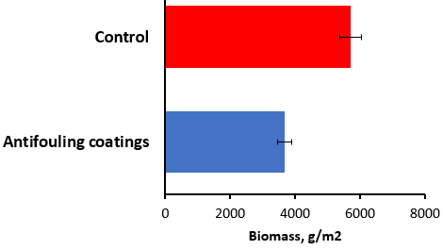
Figure 2. Total biomass of fouling organisms on control plates and plates with antifouling coatings (combined data for all coating types)
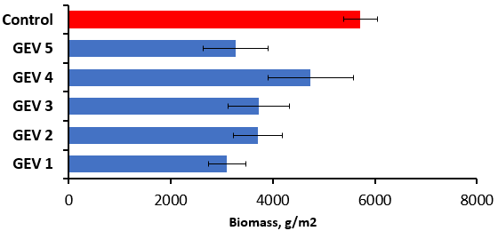
Figure 3. Total biomass of fouling organisms on control plates and plates with all kinds of experimental coatings
According to the results of ANOVA, the orientation of the plates (front/reverse) did not have a statistically significant effect on total fouling biomass (F=1.35; p=0.255), although the biomass on the reverse side (in the hydrodynamic shadow) tended to be slightly lower than on the front side (Figure 4). This trend was clearly visible. It is possible that a larger number of both experimental and control samples are needed to confirm it at the required significance level.
No significant effect of depth (the order of plate placement on the cassette from top to bottom) on the total contaminant biomass was found (F=0.51; p=0.763). No trend in biomass change with depth was observed (Figure 5).
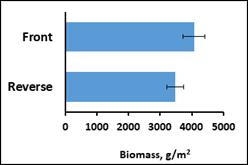
Figure 4. Total biomass of fouling organisms on the frontal and reverse sides of the plates
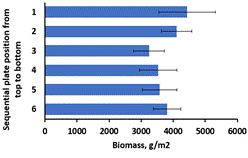
Figure 5. Total biomass of fouling organisms on plates positioned at different depths within the cassette
It is worth mentioning that PERMANOVA did not reveal any significant effect of coating composition on the species composition of the fouling communities formed on the tested samples (Pseudo-F=1.148; p=0.282). This indicates that the biocides used did not alter the community structure of the fouling organisms, nor did they exhibit selective toxicity towards specific components of the community. Nonetheless, an overall reduction in biomass was observed with biocide use. Therefore, it can be hypothesized that the biocides applied act more or less equally against all types of macrofoulers inhabiting the testing site.
Visual assessment of fouling intensity
The intensity of fouling was recorded visually using photographs (Figure 6). As Figure 6 shows, biofouling is already clearly visible on the plates exposed to the sea for 1.5 months. Biofouling then develops rapidly, and after just one year of exposure, large bivalves, ascidians, and barnacles are present on the plates in addition to colonial forms.
A correct comparison of the gravimetric and visual methods for assessing fouling intensity is only possible at a single point in time, as gravimetric assessment requires removing the fouling from the plates. In our study, this assessment was carried out after two years of exposure of the plates to the sea. Therefore, for plates exposed for two years, visual assessment of fouling intensity was most accurately performed using image analysis methods.
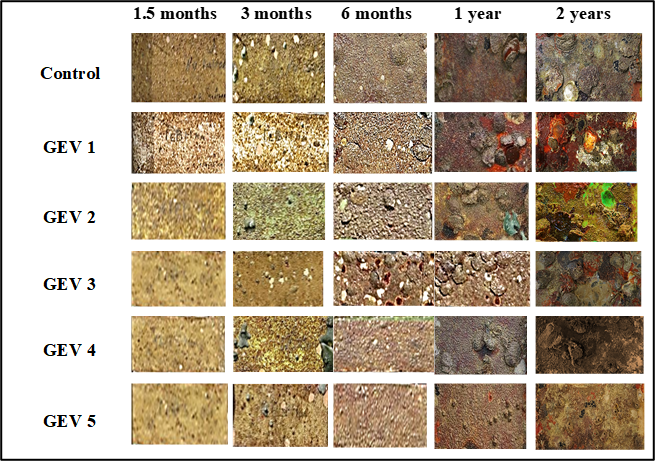
Figure 6. Images of the surface of experimental coatings after exposure to seawater for 1.5, 3, 6 months, 1 and 2 years in Nha Trang Bay
After two years the projective cover of fouling organisms on all tested plates ranged from 95 to 100%. At such a high coverage level, the scoring method recommended by GOST RВ 9.412-2001 for evaluating fouling intensity becomes uninformative, as it masks any existing differences. According to GOST, when fouling coverage exceeds 50%, a score of 1 is assigned, and finer gradations are not provided.
The projected coverage value on any of the plates with antifouling coatings did not differ significantly from that of the control: GEV 1 (p=0.788); GEV 2 (p=0.274); GEV 3 (p=0.186); GEV 4 (p=0.726); GEV 5 (p=0.396) (Figure 7). No significant difference was detected between the projected coverage on the control plates and the mean projected coverage across all plates with antifouling coatings (p=0.558) (Figure 8).
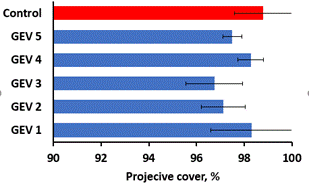
Figure 7. Projected coverage of fouling organisms on control plates and plates with applied antifouling compositions
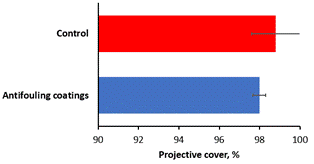
Figure 8. Projected coverage of fouling organisms on control plates and plates with applied antifouling compositions (combined data for all coating types)
The high projected coverage values and the lack of statistically significant differences suggest that, over prolonged periods (more than one year), visual assessment methods are ineffective for evaluating the efficacy of environmentally friendly antifouling formulations. The fouling organisms almost entirely cover the surface of the plates, and the differences in fouling intensity are primarily related to the thickness of the biofouling layer, which cannot be accurately assessed visually from photographs. Thus, our results suggest that future studies should not rely solely on visual assessment (as commonly applied in standard GOST-based approaches) for long-term exposure tests in tropical marine environments, but should necessarily incorporate gravimetric measurements and detailed estimation of the species composition and structure of fouling community.
Conclusion
The wet weight method exhibits higher sensitivity and accuracy than surface area-based (visual) assessment in long-term test, especially in cases of intense fouling development on the test samples.
Influence of the plate orientation on the experimental results was not possible to confirm with 0.05 significance level. However, the difference in fouling between front and reverse sides of plates was clearly visible. It is possible that a larger number of both experimental and control samples are needed to confirm it.
The efficacy of silver nanoparticles, which gradually leach out from the porous carrier aluminum hydroxide, was comparable to that of traditional biocides based on zinc and copper compounds under the same experimental conditions. So, silver nanoparticles can be a foundation for the development of environmentally friendly antifouling coatings.
Funding: This research was funded by the Institute of Silicate Chemistry - Branch of Petersburg Nuclear Physics Institute of National Research Center “Kurchatov Institute” (state task, number: 1024030700041-2-1.4.3) the Ministry of Science and Higher Education of the Russian Federation (project: “Ekolan’ T-1.6), the Joint Vietnam - Russia Tropical Science and Technology Research Center, and the Zoological Institute of Russian Academy of Sciences (state task, reg. number: 125012800889-2).
Author contributions: V.V. Khalaman: Investigation, Data curation, Formal analysis, Writing – original draft, Writing – review & editing. I.B. Glebova: Methodology, Investigation, Visualization, Writing – review & editing. O.A. Shilova: Writing – original draft, Writing – review & editing, Supervision. V.I. Voshchikov: Investigation, Writing – original draft. Ya.A. Khamidulin: Investigation, Writing – original draft. G.S. Sokolov: Methodology, Investigation. Nguyen Van Chi: Supervision, Writing – review & editing.
Data Availability Statement: All relevant data supporting the findings of this study are included within the article.
Statement on the Use of Generative AI (GenAI): No AI Used
Conflict of interest statement: The authors declare that they have no known competing financial interests or personal relationships that could have appeared to influence the work reported in this paper.
Tài liệu tham khảo
Abacharaev, M. M., & Abacharaev, I. M. (2011). Promising developments in combating marine fouling. Bulletin of ASTU, Series: Marine Engineering and Technology, 3, 7–9.
Anwar, S., & Li, X. (2024). A review of high-quality epoxy resins for corrosion-resistant applications. Journal of Coatings Technology and Research, 21, 461–480. https://doi.org/10.1007/s11998-023-00865-54
Chava, A. I., & Mokievsky, V. O. (2002). Marine fouling of structures and methods of combating it. In Modern approaches and promising technologies in the development projects of Russian shelf oil and gas fields (pp. 149–155).
Chi, V. N., Kien, V. D., Quan, H. L., Linh, N. C., Quang, Q. N., Anh, D. N., Yen, H. T. P., & Hung, Q. L. (2022). Biological macrofouling and electrochemical corrosion properties of structural steel AH36 in natural seawater at Hon Tre Island, Nha Trang. Journal of Science and Technology, 60, 1044–1055. https://doi.org/10.15625/2525-2518/16473
Elia, A. C., Magara, G., Pastorino, P., Zaccaroni, A., Caldaroni, B., Andreini, R., Righetti, M., Silvi, M., Dörr, A. J. M., & Prearo, M. (2022). Ecotoxicity in Hyriopsis bialatus of copper and zinc biocides used in metal-based antifouling paints. Environmental Science and Pollution Research, 29, 18245–18258. https://doi.org/10.1007/s11356-021-17069-2
Jaramillo, A. F., Montoya, L. F., Prabhakar, J. M., Sanhueza, J. P., Fernández, K., Rohwerder, M., Rojas, D., Montalba, C., & Melendrez, M. F. (2019). Formulation of a multifunctional coating based on polyphenols extracted from the pine radiata bark and functionalized zinc oxide nanoparticles: Evaluation of hydrophobic and anticorrosive properties. Progress in Organic Coatings, 135, 191–204. https://doi.org/10.1016/j.porgcoat.2019.06.011
Karpov, V. A., Poltarukha, O. P., & Kovalchuk, Y. L. (2018). Study of the development of marine fouling on copper-containing paints and non-toxic substrates in the tropics. Volga Economic Journal, 4, 28–34.
Kharchenko, U. V., Egorkin, V. S., Vyalyi, I. E., Sinebrjukhov, S. L., & Gnedenkov, S. V. (2024). Anti-fouling coatings based on nature-inspired technologies for use in marine environments. Bulletin of the Far Eastern Branch of the Russian Academy of Sciences, 6, 56–72. https://doi.org/10.31857/S0869769824060059
Lenoble, V., Layglon, N., Pages, C., D’Onofrio, S., & Misson, B. (2026). Deciphering copper and zinc leaching from antifouling paints with different operating modes: Flux determination and toxicity evidence. Marine Pollution Bulletin, 225, Article 119265. https://doi.org/10.1016/j.marpolbul.2026.119265
Mahmoud, H., Marie, S., Souche, J. C., Cunge, E., Giraudel, C., & Paireau, O. (2021). Influence of the intrinsic characteristics of cementitious materials on biofouling in the marine environment. Sustainability, 13, 2625–2649. https://doi.org/10.3390/su13052625
Makhmetova, A. R., Negim, E. S., Ainakulova, D. T., Yeligbayeva, G., & Khatib, J. M. (2024). An overview of epoxy resins as coating to protect metals from corrosion. Complex Use of Mineral Resources, 328(1), 20–32. https://doi.org/10.31643/2024/6445.03
Pecherkin, V. Y., Deshevaya, E. A., Vasyliak, L. M., Vasyliak, S. L., Fatyushin, A. M., Fialkina, S. V., & Hoang, K. K. (2023). Field testing of titanium dioxide coatings on metal surfaces preventing biofouling under tropical climate conditions. Physical Materials Science, 6, 60–65. https:/doi.org/10.51368/1996-0948-2023-6-60-65
Smirnova, L. L. (2021). Methodology for studying fouling in the coastal waters of the Black Sea and expedition research in the Atlantic and Indian Oceans [Monograph]. https://doi.org/10.33075/978-5-6047088-1-1
Szmechtyk, T., Efenberger-Szmechtyk, M., & Czyżowska, A. (2026). Antifouling epoxy coatings with Scots pine bark extracts. Molecules, 31, Article 137. https://doi.org/10.3390/molecules31010137
Thomas, P., Sahoo, B. N., Thomas, P. J., & Greve, M. M. (2024). Recent advances in emerging integrated anticorrosion and antifouling nanomaterial-based coating solutions. Environmental Science and Pollution Research, 31, 67550–67576. https://doi.org/10.1007/s11356-024-33825-6
Walter, T., Langbein, M., Blenk, P., Tesler, A. B., Prado, L. H., Bornstein, D., Virtanen, S., Castiglione, K., & Vogel, N. (2024). Performance of environmentally friendly, liquid-infused coatings against biofouling: Evaluation of macrofouling and microbially induced corrosion in freshwater environments. Journal of Materials Chemistry, 12, 15278–15289. https://doi.org/10.1039/d4ta00741g