

Thanh bên bài viết

 CC BY 4.0
Truy cập mở
CC BY 4.0
Truy cập mở
Được sao chép, phân phối lại và chỉnh sửa bài báo, với điều kiện:
-
Ghi nguồn tác giả và bài báo gốc
© 2025 Tạp chí Khoa học và Công nghệ nhiệt đới
Thông tin kết quả nghiên cứu công nghệ chế tạo than hoạt tính tẩm kim loại Cu-Ag-Cr quy mô pilot xử lý khí hydro sunfua và amoniac trong không khí
Nội dung chính của bài viết
Tóm tắt
Nghiên cứu trình bày quy trình chế tạo than hoạt tính tẩm Cu-Ag-Cr trên hệ thiết bị tẩm sấy chân không quy mô pilot ứng dụng trong xử lý khí NH3 và H2S trong môi trường khép kín trên tàu ngầm. Quy trình tẩm thực hiện ở áp suất -0,09 Mpa trong thời gian 60 phút, sau đó hoạt hóa ở nhiệt độ 175 ± 5oC trong thời gian 120 phút. Kết quả cho thấy, than hoạt tính tẩm Cu-Ag-Cr có chất lượng đồng đều và độ ổn định cao, hiệu suất tẩm kim loại đạt 95,58% (Cu), 93,25% (Cr) và 88,97% (Ag). Dung lượng hấp phụ khí NH3 và H2S của than hoạt tính lần lượt đạt 102 mg/g và 200 mg/g. Than hoạt tính tẩm Cu-Ag-Cr chế tạo theo quy trình đáp ứng đầy đủ các yêu cầu kỹ thuật trong chế tạo phin lọc FK-U2 xử khí NH3 và H2S, góp phần bảo đảm sức khỏe thủy thủ và hiệu suất vận hành thiết bị trên tàu ngầm.
Abstract
Research on the pilot-scale fabrication technology of Cu-Ag-Cr impregnated activated carbon for the removal of hydrogen sulfide and ammonia from air
This study successfully demonstrates the pilot-scale synthesis of a Cu-Ag-Cr tri-metallic impregnated activated carbon using a vacuum impregnation-drying system, designed for the efficient removal of NH₃ and H₂S in enclosed submarine atmospheres. The optimized protocol comprised impregnation at -0.09 MPa for 60 minutes, followed by thermal activation at 175 ± 5°C for 120 minutes. The resulting adsorbent exhibited excellent uniformity and stability, achieving high metal impregnation efficiencies of 95.58% (Cu), 93.25% (Cr), and 88.97% (Ag). Evaluation of its gas adsorption performance revealed substantial capacities, reaching 102 mg/g for NH₃ and 200 mg/g for H₂S. The developed material meets all technical specifications for the production of FK-U2 filter cartridges, confirming its strong potential for practical application in ensuring crew safety and maintaining the operational integrity of submarine systems.
Keywords: Air filter cartridge; Cu-Ag-Cr impregnated activated carbon; pilot scale; toxic gas adsorption; vacuum impregnation-drying.
Từ khóa
Hấp phụ khí độc, tẩm sấy chân không, phin lọc không khí, quy mô pilot, than hoạt tính tẩm Cu-Ag-Cr
Chi tiết bài viết
Điểm nổi bật:
Xây dựng thành công quy trình chế tạo than hoạt tính tẩm Cu-Ag-Cr quy mô pilot trên hệ thiết bị tẩm sấy chân không tích hợp tháp xử lý khí NH₃.
Lựa chọn điều kiện tối ưu tẩm Cu-Ag-Cr trên than hoạt tính: tẩm ở áp suất -0,09 Mpa trong thời gian 60 phút, sau đó hoạt hóa ở 175 ± 5oC trong thời gian 120 phút.
Quy trình chế tạo có độ ổn định cao, chất lượng than hoạt tính đồng đều, đáp ứng đầy đủ các tiêu chuẩn chế tạo phin lọc FK-U2 trên tàu lớp P.
1. ĐẶT VẤN ĐỀ
Trong môi trường khép kín với hàng nghìn chất khí độc hại trên tàu ngầm hay tàu vũ trụ cần sử dụng hệ thống thiết bị lọc không khí để duy trì không khí sạch cho con người sinh hoạt và làm việc. Trên tàu ngầm, hoạt động sinh hoạt của thủy thủ phát thải một lượng đáng kể khí hydrogen sulfide (H2S) và amoniac (NH3) tích tụ trong không khí có tính kích ứng với mùi khó chịu, dễ gây ăn mòn thiết bị, ngộ độc chất xúc tác và nhiều tác động bất lợi khác. Tiếp xúc với khí NH3 ở nồng độ 50-100 ppm có thể gây kích ứng mắt, cổ họng và mũi, ở nồng độ cao trên 300 ppm có thể gây thương tật vĩnh viễn hoặc thậm chí tử vong [1]. Trong khi đó, phơi nhiễm cấp tính với khí H2S ở nồng độ cao gây ra nhiễm độc hệ thần kinh, suy hô hấp cấp, và cũng có thể dẫn đến tử vong [2]. Do đó, nghiên cứu phát triển các vật liệu xử lý đồng thời khí NH3 và H2S ngay ở nhiệt độ phòng trong các môi trường khép kín là vấn đề mang tính thời sự và thu hút sự quan tâm lớn của các nhà khoa học trên thế giới.
Hiện nay, các vật liệu phổ biến sử dụng trong xử lý khí độc NH3 và H2S bao gồm vật liệu xúc tác quang học, vật liệu zeolit trao đổi ion, vật liệu màng lọc sinh học, vật liệu hấp phụ trên nền than hoạt tính… Trong đó, vật liệu lọc xúc tác quang học xử lý khí độc dựa trên cơ chế oxy hóa dưới tác dụng của nguồn sáng với tốc độ phản ứng nhanh và hiệu quả xử lý cao [3]. Tuy nhiên, cơ chế này phụ thuộc nhiều vào nguồn sáng, độ ẩm tương đối, hàm lượng oxy và nồng độ ban đầu của khí độc [4, 5]. Vật liệu zeolit trao đổi ion cho hiệu quả xử lý tốt với khí NH3 nhưng lại có hiệu quả hạn chế đối với khí H2S [6]. Công nghệ xử lý bằng màng lọc sinh học thân thiện với môi trường, chi phí thấp nhưng tốc độ phản ứng chậm, cần không gian rộng và duy trì điều kiện nhiệt độ, độ ẩm và độ pH ổn định [7, 8]. Trong bối cảnh đó, vật liệu hấp phụ trên nền than hoạt tính nổi lên là một lựa chọn ưu việt với khả năng xử lý đồng thời khí NH3 và H2S nhanh chóng, hiệu quả ổn định trong môi trường khép kín và độ ẩm cao như trên tàu ngầm. Đối với xử lý từng khí NH3 hoặc H2S riêng biệt, việc ngâm tẩm than hoạt tính với axit [9] hoặc kiềm [10, 11] mang lại hiệu quả tốt. Tuy nhiên, để loại bỏ đồng thời cả hai khí trong môi trường khép kín trên tàu ngầm thì các muối của kim loại chuyển tiếp đã được nghiên cứu để tẩm lên than hoạt tính nhằm cải thiện dung lượng hấp phụ. Trong nhiều nghiên cứu khác nhau [12-16] đã chỉ ra rằng, kim loại Cu, Ag, Cr và các hợp chất của chúng khi được ngâm tẩm lên than hoạt tính đem lại hiệu quả cao trong xử lý khí độc NH3, H2S, HCN…
Trong các nghiên cứu gần đây [17, 18], chúng tôi đã xây dựng thành công quy trình chế tạo than hoạt tính tẩm Cu-Ag-Cr quy mô phòng thí nghiệm (2 kg/mẻ) ứng dụng trong sản xuất phin lọc làm sạch không khí FK-U2 sử dụng trên tàu P. Trong đó, than hoạt tính được tẩm ở áp suất -0,95 Mpa, sau đó hoạt hóa ở nhiệt độ 175 ± 5oC trong thời gian 2 giờ, hàm lượng kim loại lần lượt là Cu 6,5%; Ag 0,035% và Cr 2%. Tuy nhiên, việc sản xuất phin lọc FK-U2 cần sử dụng khối lượng lớn than hoạt tính tẩm Cu-Ag-Cr mà quy mô thí nghiệm không thể đáp ứng nhu cầu. Trong nghiên cứu này, chúng tôi nghiên cứu xây dựng quy trình công nghệ chế tạo than hoạt tính Cu-Ag-Cr quy mô pilot (10 kg/mẻ) trên hệ thiết bị tẩm sấy chân không đồng bộ thiết bị xử lý khí NH₃ với chất lượng ổn định và độ đồng đều cao.
2. ĐỐI TƯỢNG VÀ PHƯƠNG PHÁP NGHIÊN CỨU
2.1. Nguyên liệu, hóa chất và thiết bị
Than hoạt tính, dạng viên Φ 0,9 mm, hàm ẩm 3%, chỉ số Iodine 1000 mg/g;
AgNO3, 7761-88-8, Trung Quốc, hàm lượng ≥ 99%;
CrO3, 1333-82-0, Trung Quốc, hàm lượng ≥ 99%;
CuCO3.Cu(OH)2.2H2O, 12069-69-1, Trung Quốc, dạng ngoài: dạng bột màu xanh, hàm lượng ≥ 98%;
NH3, 1336-21-6, Trung Quốc, hàm lượng 25~28%;
Hệ thống thiết bị tẩm sấy chân không SZG-200: Áp suất âm tối đa -0,09 ~ -0,096 Mpa, nhiệt độ sấy tối đa 250oC, tháp xử lý khí NH3 bằng màng nước;
Máy lắc sàng rây LMSM 300/450 Laarmann (Hà Lan);
Sensor đo khí NH3 module ZE03-NH3, dải đo (0 ~ 200) ppm, độ chính xác 1 ppm, dải điện áp đầu ra (0,6 ~ 3,0) V;
Sensor đo khí H2S module ZE03- H2S, dải đo (0 ~ 200) ppm, độ chính xác 1 ppm, dải điện áp đầu ra (0,6 ~ 3,0) V.
2.2. Phương pháp nghiên cứu
a) Phương pháp tẩm kim loại
Chuẩn bị dung dịch tẩm (tẩm 10 kg than hoạt tính): Lấy 1,0 kg NH4HCO3 và 1,84 kg CuCO3.Cu(OH)2.2H2O hòa tan hoàn toàn trong 6,0 L dung dịch NH3 25~28% thu được dung dịch 1. Hòa tan hoàn toàn 580 g CrO3 trong 500 mL NH3 25% và 1,5 L H2O thu được dung dịch 2. Lấy 125 g AgNO3 hoàn tan trong 500 mL nước cất thu được dung dịch 3. Cho lần lượt dung dịch 3 và dung dịch 2 vào dung dịch 1 khuấy đều trong 30 phút thu được dung dịch tẩm.
Điều kiện tẩm: áp suất -0,09 Mpa, thời gian tẩm 60 phút, tốc độ quay thân bồn 10 vòng/phút. Điều kiện hoạt hóa: nhiệt độ 175 ± 5oC trong thời gian 120 phút.
b) Phương pháp kiểm tra chất lượng than hoạt tính tẩm Cu-Ag-Cr
Hàm lượng kim loại: Phương pháp EPA Method 3051, 7010 và 7000B (phân tích trên F-AAS);
Hàm ẩm: Thực hiện trên cân phân tích hàm ẩm DSH-10A.
Khối lượng riêng đong ρ: Đưa than hoạt tính vào ống đong đến thể tích khoảng (50~70) mL. Xác định thể tích V trong ống đong sau khi rung ở tần số 140~160 lần/phút trong 15 giây và khối lượng m của vật liệu. Khối lượng riêng đong của vật liệu được tính theo công thức:
 (1)
(1)
Kiểm tra dung lượng hấp phụ khí NH3 và H2S: Cân chính xác 0,8 g mẫu than hoạt tính cho vào ống thủy tinh đường kính 6 mm, tạo ra cột than cao khoảng 50 mm. Bơm khí NH3 nồng độ 500 ppm hoặc khí H2S nồng độ 100 ppm, tốc độ dòng khí là 1 lít/phút liên tục qua cột than. Dung lượng hấp phụ được tính theo khối lượng tăng lên trên mỗi gram than. Dung lượng hấp phụ tính bằng kết quả trung bình của 03 lần thử.
Kiểm tra độ bền hạt: Lấy (50 ± 3) g hạt than hoạt tính đường kính lỗ ≥ 0,5 mm. Lấy 05 viên bi sứ đường kính 22 mm cho vào mâm cầu với hạt than hoạt tính, đậy nắp và chạy ở tần số (150 ± 3) lần/phút trong 30 phút. Phần hạt than hoạt tính còn lại được sàng lại trên sàng Φ 0,5 mm trong 60 giây ở tần số 140~160 lần/ phút. Kết thúc quá trình rây, cân lượng hạt than hoạt tính A còn lưu lại trên sàng đường kính lỗ 0,5 mm (chính xác đến 0,1 g). Độ bền hạt được tính theo công thức sau:
(2)
3. KẾT QUẢ VÀ THẢO LUẬN
3.1. Nghiên cứu tối ưu hóa điều kiện tẩm và điều kiện hoạt hóa trên hệ thống tẩm sấy chân không tích hợp tháp xử lý khí NH3 dư
3.1.1. Hệ thống tẩm sấy chân không tích hợp tháp xử lý khí NH3 dư
Quy trình chế tạo than hoạt tính quy mô pilot được xây dựng dựa trên các kết quả nghiên cứu điều kiện tẩm và điều kiện hoạt hóa ở quy mô phòng thí nghiệm [17,18]. Ở quy mô pilot sử dụng thiết bị tẩm sấy chân không cho phép thực hiện liên tiếp cả hai công đoạn tẩm và sấy hoạt hóa. Sơ đồ hệ thống thiết bị như trong Hình 1.
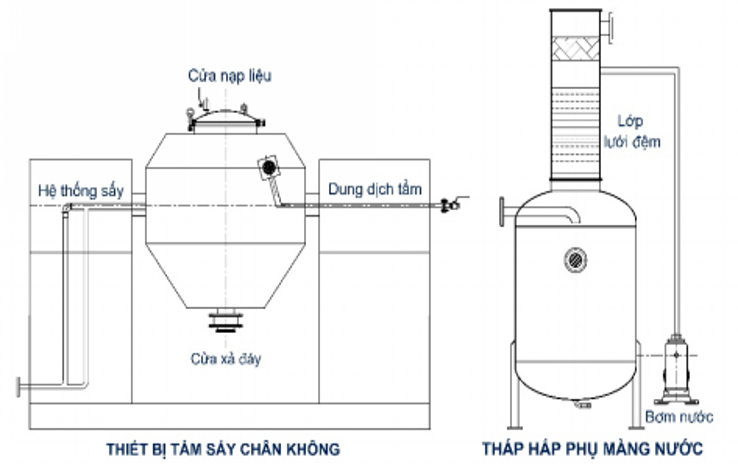
Hình 1. Sơ đồ thiết bị tẩm sấy chân không tích hợp tháp hấp thụ NH3.
Thiết bị tẩm sấy chân không có kết cấu hình nón đôi có thể quay quanh trục kết hợp với đầu phun áp lực giúp phân tán đều dung dịch tẩm lên than họat tính. Thiết kế này là một cải tiến so với phương pháp tẩm ở quy mô phòng thí nghiệm khi than hoạt tính được ngâm tĩnh trong dung dịch. Sau công đoạn tẩm, thiết bị thực hiện ngay quá trình gia nhiệt để nung hoạt hóa mà không cần chuyển sang thiết bị khác như phương pháp cũ. Trong quá trình nhiệt phân, các phức chất của Cu, Cr, Ag với amoniac bị phân hủy hình thành các oxit kim loại và giải phóng một lượng lớn khí NH3. Do khí NH3 không thể xả thải trực tiếp ra môi trường nên toàn bộ lượng khí này sẽ được dẫn vào tháp hấp thụ màng nước. Bên trong tháp, nước được bơm tuần hoàn từ đáy lên đỉnh tháp, chảy qua hệ thống lưới đệm để tạo màng nước mỏng từ trên xuống giúp hấp thụ khí NH3 ở đáy tháp.
Hệ thống thiết bị tẩm sấy chân không tích hợp tháp hấp thụ xử lý khí NH3 cho phép thực hiện đồng thời quá trình tẩm và hoạt hóa trong môi trường chân không giúp nâng cao hiệu suất tẩm. Hệ thống khép kín giúp kiểm soát và xử lý có hiệu quả khí thải NH3, góp phần nâng cao tính an toàn và thân thiện với môi trường của quy trình chế tạo.
3.1.2. Nghiên cứu ảnh hưởng của thời gian tẩm đối với dung lượng hấp phụ khí NH3 và H2S
Để nghiên cứu ảnh hưởng của thời gian tẩm đối với dung lượng hấp phụ khí độc, chúng tôi cố định các điều kiện tẩm như hàm lượng kim loại trong dung dịch tẩm, áp suất tẩm -0,09 Mpa, thay đổi thời gian tẩm lần lượt trong 30 phút, 60 phút, 90 phút và 120 phút. Sau đó, các mẫu được hoạt hóa ở cùng điều kiện 175 ± 5oC trong thời gian 120 phút. Kết quả thử nghiệm tổng dung lượng hấp phụ khí H2S và NH3 của các mẫu than hoạt tính tẩm trong thời gian khác nhau được thể hiện trong Hình 2.
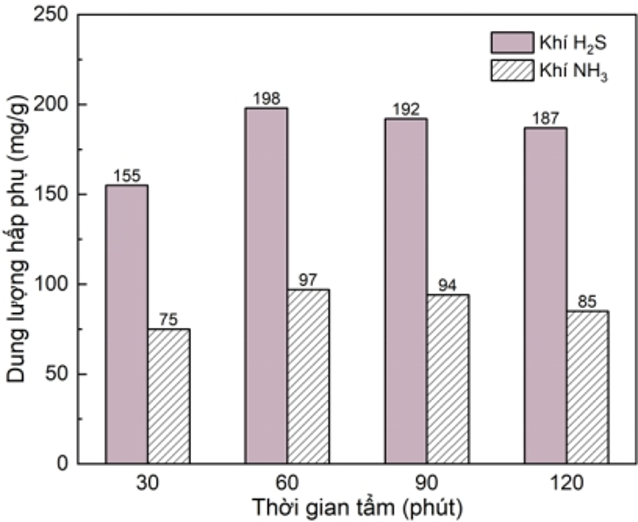
Hình 2. Ảnh hưởng của thời gian tẩm với dung lượng hấp phụ NH3, H2S.
Mẫu tẩm trong 30 phút có tổng dung lượng hấp phụ khí độc thấp nhất chỉ đạt 155 mg/g với H2S và 75 mg/g với NH3. Mẫu tẩm trong 60 phút có tổng dung lượng hấp phụ khí độc cao nhất (198 mg/g với H2S và 97 mg/g với NH3), tương đương với kết quả tẩm ở quy mô phòng thí nghiệm (192 mg/g với H2S và 103 mg/g với NH3) [17]. Mẫu tẩm trong thời gian 90 phút và 120 phút có dung lượng hấp phụ khí H2S và NH3 giảm so với mẫu tẩm trong 60 phút. Kết quả này cho thấy, việc tăng thời gian tẩm giúp tăng khả năng xử lý khí độc của than, tuy nhiên sau khi đạt trạng thái bão hòa nếu tiếp tục tăng thời gian tẩm sẽ làm giảm dung lượng hấp phụ. Điều này có thể lý giải do kích thước lỗ xốp than hoạt tính rất nhỏ (từ 2 nm đến 50 nm) và dung dịch tẩm có độ nhớt nhất định dẫn đến trở lực thẩm thấu rất lớn, cần thời gian nhất định để dung dịch tẩm khuếch tán vào trung tâm lỗ xốp. Sau khi hàm lượng chất mang trên than hoạt tính đạt đến trạng thái bão hòa, nếu tiếp tục tăng thời gian tẩm có thể dẫn đến hiện tượng chênh lệch về áp suất và nồng độ khiến chất mang bị đẩy ngược trở lại dung dịch tẩm từ đó làm giảm dung lượng hấp phụ.
3.1.3. Nghiên cứu ảnh hưởng của thời gian hoạt hóa đối với dung lượng hấp phụ khí NH3 và H2S
Để nghiên cứu sự ảnh hưởng của thời gian hoạt hóa đối với khả năng xử lý khí độc, than hoạt tính sau khi tẩm trong thời gian 60 phút sẽ được hoạt hóa ở nhiệt độ 175oC ± 5oC trong thời gian 60, 90, 120, 150 và 180 phút.
Kết quả được trình bày trong Hình 3, có thể thấy sau 60 phút hoạt hóa dung lượng hấp phụ khí độc ở mức thấp 76 mg/g H2S và 65 mg/g NH3. Khi tăng thời gian hoạt hóa lên 90 và 120 phút dung lượng hấp phụ tăng nhanh rõ rệt và đạt giá trị cực đại tại thời điểm 120 phút với dung lượng hấp phụ H2S và NH3 đạt lần lượt 195 mg/g và 105 mg/g, tương đương với dung lượng hấp phụ khí độc của than hoạt tính chế tạo theo quy mô phòng thí nghiệm (192 mg/g H2S và 103 mg/g H2S) [17]. Nguyên nhân là khi thời gian hoạt hóa ngắn (60 phút) không đủ để nhiệt phân hoàn toàn các phức muối kim loại thành oxit kim loại nên dung lượng hấp phụ khí độc thấp. Sau khi đã nhiệt phân hoàn toàn các phức kim loại (120 phút), nếu tiếp tục tăng thời gian hoạt hóa thì dung lượng xử lý thay đổi chậm và có xu hướng giảm xuống có thể do một phần than hoạt tính bắt đầu bị tro hóa làm phá vỡ cấu trúc lỗ xốp của than.
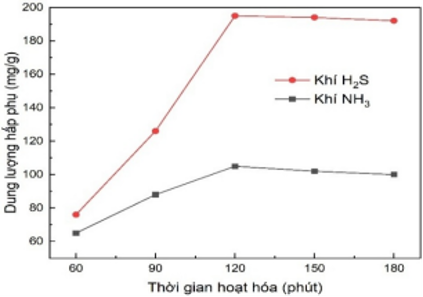 |  |
Hình 3. Ảnh hưởng của thời gian hoạt hóa đối với dung lượng hấp phụ khí độc.
Trên cơ sở các phân tích nêu trên, chúng tôi đã lựa chọn được điều kiện tối ưu chế tạo than hoạt tính tẩm Cu-Ag-Cr trên hệ thiết bị tẩm sấy chân không quy mô pilot: tẩm ở áp suất -0,90 Mpa trong thời gian 60 phút, sau đó hoạt hóa ở 175 ± 5oC trong 120 phút.
3.2. Nghiên cứu độ đồng đều của than hoạt tính chế tạo theo quy mô pilot
Để đánh giá độ đồng đều của than hoạt tính ở các phân đoạn khác nhau trong bồn tẩm, thực hiện lấy ngẫu nhiên 06 mẫu thuộc 03 phân đoạn trong cùng một lần tẩm: 02 mẫu ở tầng đáy (TĐ-01, TĐ-02), 02 mẫu ở tầng giữa (TG-01, TG-02) và 02 mẫu ở tầng trên (TT-01, TT-01). Kết quả kiểm tra hàm lượng và hiệu suất tẩm kim loại trên than hoạt tính ở các phân đoạn được thể hiện trong Hình 4. Kết quả phân tích cho thấy, các mẫu than hoạt tính ở các phân đoạn khác nhau trong buồng trộn có độ đồng đều cao thể hiện qua giá trị trung bình và hệ số biến thiên CV% của hàm lượng kim loại và hiệu suất tẩm (hàm lượng kim loại đo thực tế so với hàm lượng kim loại tính toán).
Hàm lượng Cu và Cr ở các phân đoạn có hệ số biến thiên CV% rất nhỏ lần lượt là 0,50% và 1,31%, sai lệch so với giá trị trung bình rất thấp cho thấy độ đồng đều rất cao. Mặc dù, hàm lượng bạc có hệ số biến thiên 5,17% cao hơn nhiều so với hàm lượng Cu và Cr, nhưng sự chênh lệch này là do hàm lượng bạc trung bình rất thấp 0,058%. Sự biến thiên tuyệt đối thể hiện qua độ lệch chuẩn SD = 0,003 là không đáng kể chứng tỏ các mẫu vẫn đảm bảo độ đồng đều tốt. Hiệu suất tẩm Cu, Ag và Cr trung bình so với hàm lượng tính toán (6,5% Cu, 1,8% Cr, 0,065% Ag) đạt lần lượt 95,58%, 93,25% và 88,97%. Tính ổn định của quy trình được khẳng định thông qua hệ số biến thiên của hiệu suất tẩm, với giá trị CV% ở mức thấp lần lượt là 0,52% Cu, 1,46% Cr và 4,66% Ag cho thấy độ đồng đều và tính đồng nhất của sản phẩm trên toàn bộ thể tích bồn trong cùng một mẻ tẩm.
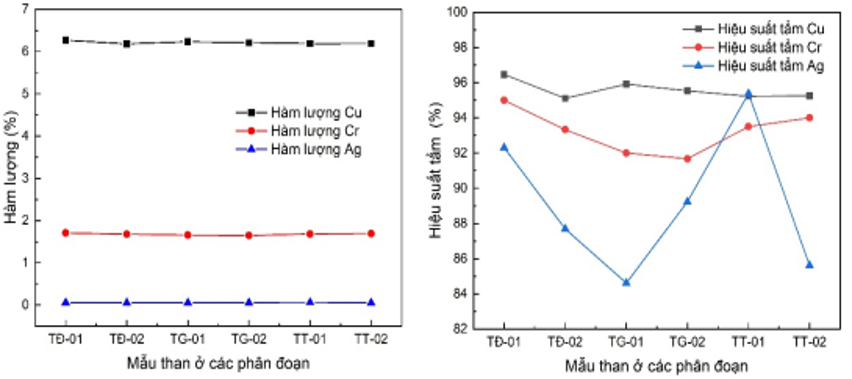
Hình 4. Kết quả kiểm tra hàm lượng và hiệu suất tẩm kim loại trên than hoạt tính.
Qua phân tích nêu trên cho thấy, các mẫu than ở các phân đoạn khác nhau trong bồn tẩm có tính đồng nhất và độ đồng đều cao. Kết quả này đã khẳng định tính ổn định của quy trình và chứng minh tính khả thi của quy mô pilot.
3.3. Hoàn thiện quy trình công nghệ chế tạo than hoạt tính tẩm Cu-Ag-Cr quy mô pilot
Trên cơ sở các kết quả lựa chọn điều kiện tẩm và đánh giá độ đồng đều của than hoạt tính chế tạo theo quy mô pilot, nhóm nghiên cứu đã tiếp tục thực hiện 15 lần tẩm theo các điều kiện tối ưu (kí hiệu mẫu từ M-01 đến M-15). Các chỉ tiêu chất lượng của than hoạt tính được kiểm tra theo mức chất lượng của Điều kiện kỹ thuật (20TK.PL.00.00.ĐK), như trong Bảng 1.
Bảng 1. Chỉ tiêu chất lượng của than hoạt tính tẩm xúc tác dùng cho phin lọc FK-U2
STT | Tên chỉ tiêu chất lượng | Đơn vị đo | Mức chất lượng |
1 | Dạng ngoài |
| Dạng hạt từ nâu đến đen |
2 | Hàm ẩm, không lớn hơn | % | 5 |
3 | Khối lượng riêng đong | g/cm3 | 0,48 ÷ 0,64 |
4 | Hàm lượng kim loại |
|
|
4.1 | Cu, không nhỏ hơn | % | 6 |
4.2 | Cr, không nhỏ hơn | % | 1,5 |
4.3 | Ag, không nhỏ hơn | % | 0,03 |
5 | Độ bền hạt, không nhỏ hơn | % | 80 |
6 | Dung lượng xử lý khí NH3, không nhỏ hơn | mg/g | 80 |
7 | Dung lượng xử lý khí H2S, không nhỏ hơn | mg/g | 152 |
Kết quả kiểm tra chất lượng của 15 mẫu than hoạt tính tẩm Cu-Ag-Cr được trình bày trong Bảng 2 và Bảng 3.
Bảng 2. Kết quả kiểm tra chất lượng than hoạt tính tẩm xúc tác.
STT | Mẫu | Màu sắc | Khối lượng riêng đong, g/cm3 | Hàm ẩm, % | Độ bền hạt, % | Dung lượng hấp phụ, mg/g | |
NH3 | H2S | ||||||
1 | M-01 | Màu nâu đen | 0,52 | 3,21 | 85 | 110 | 205 |
2 | M-02 | Màu nâu đen | 0,56 | 2,07 | 90 | 112 | 210 |
3 | M-03 | Màu nâu đen | 0,50 | 3,30 | 91 | 98 | 204 |
4 | M-04 | Màu nâu đen | 0,51 | 3,17 | 87 | 108 | 216 |
5 | M-05 | Màu nâu đen | 0,52 | 2,96 | 90 | 92 | 200 |
6 | M-06 | Màu nâu đen | 0,56 | 3,42 | 85 | 115 | 209 |
7 | M-07 | Màu nâu đen | 0,50 | 3,12 | 85 | 102 | 204 |
8 | M-08 | Màu nâu đen | 0,52 | 2,70 | 83 | 110 | 198 |
9 | M-09 | Màu nâu đen | 0,50 | 3,37 | 90 | 96 | 200 |
10 | M-10 | Màu nâu đen | 0,53 | 3,32 | 91 | 95 | 196 |
11 | M-11 | Màu nâu đen | 0,54 | 2,90 | 86 | 98 | 180 |
12 | M-12 | Màu nâu đen | 0,56 | 3,42 | 85 | 105 | 195 |
13 | M-13 | Màu nâu đen | 0,54 | 3,50 | 90 | 95 | 199 |
14 | M-14 | Màu nâu đen | 0,56 | 3,28 | 86 | 101 | 202 |
15 | M-15 | Màu nâu đen | 0,50 | 3,30 | 92 | 97 | 188 |
Trung bình | 0,53 | 3,14 | 88 | 102 | 200 | ||
Bảng 3. Kết quả kiểm tra hàm lượng Cu-Ag-Cr trong than hoạt tính.
STT | Mẫu | Hàm lượng Cu, % | Hàm lượng Cr, % | Hàm lượng Ag, % |
1 | M-01 | 6,270 | 1,710 | 0,060 |
2 | M-02 | 6,120 | 1,640 | 0,040 |
3 | M-03 | 6,410 | 1,550 | 0,040 |
4 | M-01-06 | 6,200 | 1,560 | 0,050 |
5 | M-01-15 | 6,180 | 1,550 | 0,043 |
Trung bình | 6,236 | 1,602 | 0,047 | |
*M-01-06 (mẫu trộn M-01 đến M-06), M-01-15 (mẫu trộn M-01 đến M-15).
Kết quả cho thấy tất cả mẫu lấy từ các mẻ chế tạo theo quy trình công nghệ quy mô pilot đều đáp ứng yêu cầu của Điều kiện kỹ thuật, đủ điều kiện sử dụng để chế tạo phin lọc FK-U2. Quy trình công nghệ chế tạo than hoạt tính quy mô pilot có độ đồng đều, độ tin cậy và tính ổn định cao.
Việc chế tạo thành công than hoạt tính tẩm Cu-Ag-Cr ở quy mô pilot mang lại hiệu quả ứng dụng cao, tuy nhiên quy trình này sử dụng CrO3 có độc tính cao. Các nghiên cứu gần đây đã tập trung vào các vật liệu dựa trên oxit kim loại chuyển tiếp như ZnO, Fe2O3, NiO, Co3O4… thay thế CrO3 để hấp phụ khí H2S ở nhiệt độ thấp [14, 19 và 20]. Nghiên cứu [21] chỉ ra rằng sự phân tán hỗn hợp oxit ZnO-CuO với tỷ lệ mol thay đổi từ 0:1 đến 1:1 trên nền than hoạt tính giúp cải thiện đáng kể khả năng hấp phụ khí độc, hệ số sử dụng pha hoạt tính đạt đến 76%. Dahao Jiang và cộng sự [22] đã điều chế hỗn hợp oxit kim loại Cu-Zn-Al bằng phương pháp đồng kết tủa với tỷ lệ mol Cu/Zn khác nhau đạt dung lượng lưu huỳnh tại điểm đột phá cao (4,4 đến 25,7 g S/100 g chất hấp phụ) ở nhiệt độ 40oC. Những kết quả này mang đến định hướng hữu ích cho các nghiên cứu trong tương lai nhằm phát triển các vật liệu xử lý khí độc trên nền than hoạt tính tẩm oxit kim loại thay thế CrO3.
4. KẾT LUẬN
Kết quả nghiên cứu đã hoàn thiện quy trình công nghệ chế tạo than hoạt tính tẩm Cu-Ag-Cr bằng phương pháp tẩm chân không ở quy mô pilot trên hệ thiết bị tẩm sấy chân không đồng bộ với tháp xử lý khí NH₃ tại Trung tâm Nhiệt đới Việt - Nga. Các điều kiện tối ưu để chế tạo vật liệu than hoạt tính tẩm Cu-Ag-Cr: áp suất tẩm -0,09 Mpa, thời gian tẩm 60 phút; nhiệt độ hoạt hóa 175 ± 5oC, thời gian hoạt hóa 120 phút. Kết quả cho thấy, than hoạt tính tẩm Cu-Ag-Cr chế tạo trên hệ thiết bị tẩm sấy chân không có độ ổn định cao, chất lượng đồng đều, hiệu suất tẩm Cu; Ag; Cr đạt lần lượt 95,58%; 93,25%; 88,97%, dung lượng hấp phụ khí NH3 và H2S trung bình đạt 102 mg/g và 200 mg/g. Trên cơ sở các kết quả nghiên cứu đã đạt được, chúng tôi sẽ tiếp tục mở rộng định hướng nghiên cứu chế tạo nhóm vật liệu hấp phụ tẩm hỗn hợp các oxit kim loại khác thay thế Cr, công nghệ xử lý các khí độc khác như NOx, CO, HCN, benzen…, công nghệ tái sinh than hoạt tính cũng như theo dõi hiệu quả sử dụng thực tế của than hoạt tính trên tàu ngầm lớp P.
Lời cảm ơn: Nhóm tác giả cảm ơn sự hỗ trợ về kinh phí của nhiệm vụ: “Hoàn thiện quy trình công nghệ chế tạo than hoạt tính tẩm xúc tác sử dụng trên các phin lọc làm sạch không khí và tiếp tục thử nghiệm thực tế trên tàu lớp P”, mã số: ĐB.N1.25/24, cấp Trung tâm Nhiệt đới Việt - Nga.
Tuyên bố về sử dụng Gen AI: Nhóm tác giả tuyên bố các công cụ AI tạo sinh không được sử dụng để tạo ra hoặc chỉnh sửa nội dung khoa học của bản thảo này. Trong phần có sử dụng công cụ AI (chỉ hỗ trợ kiểm tra ngữ pháp/định dạng), các tác giả đã kiểm tra toàn bộ nội dung và hoàn toàn chịu trách nhiệm đối với nội dung cuối cùng.
Tuyên bố về đóng góp của tác giả: Nguyễn Trọng Nghĩa: Chuẩn bị bản thảo gốc, xử lý số liệu, chỉnh sửa bản thảo; Nguyễn Hữu Đông: Thực nghiệm, xử lý số liệu; Dương Quốc Bảo:Tổng quan, xử lý số liệu; Đỗ Văn Quý: Phương pháp luận, thực nghiệm, xử lý số liệu; Nguyễn Hùng Thái: Chuẩn bị bản thảo gốc, phương pháp nghiên cứu; Vũ Trần Dương: Tổng quan, xử lý số liệu; Hà Ngọc Thiện: Phương pháp nghiên cứu, chỉnh sửa bản thảo.
Tuyên bố về xung đột lợi ích: Bài báo không có bất kỳ xung đột lợi ích với bất kỳ các tác giả nào.
Tài liệu tham khảo
- Baishali Kanjilal, Arameh Masoumi, Nourouddin Sharifi and Iman Noshadi, Ammonia harms and diseases: ammonia corrosion chazards on human body systems (liver, muscles, kidney, brain) in Progresses in Ammonia: Science, Technology and Membranes, Angelo Basile editor. Elsevier, 2024, pp. 307-324.
- A Saeedi, A Najibi and A Mohammadi-Bardbori, Effects of long-term exposure to hydrogen sulfide on human red blood cells, The International Journa of Occupational and Environmental Medicine, Vol. 6, No. 1, pp. 20-25, 2015. DOI: 10.15171/ijoem.2015.482
- Yukino Uesugi, Haruki Nagakawa and Morio Nagata, Highly efficient photocatalytic degradation of hydrogen sulfide in the gas phase using Anatase/TiO2(B) Nanotubes, ACS Omega, Vol. 7, No. 14, pp. 11946-11955, 2022. DOI: 10.1021/acsomega.1c07294
- Marlon Brancher, Davide Franco and Henrique de Melo Lisboa, Photocatalytic oxidation of H2S in the gas phase over TiO2-coated glass fiber filter, Environmental Technology, Vol. 37, No. 22, pp. 2852-2864, 2016. DOI: 10.1080/09593330.2016.1167250
- Yajie Shu, Danni Wang, Jinfeng Wang and Haibao Huang, Adsorption and photocatalytic degradation of ammonia: status and challenges, Chemical Engineering Journal, Vol. 498, p. 154925, 2024. DOI: 10.1016/j.cej.2024.154925
- Annika Starke, Christoph Pasel, Christian Bläker, Tobias Eckardt, Jens Zimmermann and Dieter Bathen, Investigation of the adsorption of hydrogen sulfide on faujasite zeolites focusing on the influence of cations, ACS Omega, Vol. 7, No. 48, pp. 43665-43677, 2022. DOI: 10.1021/acsomega.2c04606
- Ying-Chien Chung, Kuo-Ling Ho and Ching-Ping Tseng, Operational characteristics of effective removal of H2S and NH3 waste gases by activated carbon biofilter, Journal of the Air & Waste Management Association, Vol. 54, No.4, pp. 450-458, 2004. DOI: 10.1080/10473289.2004.10470915
- Qiuyan Zhu et al, Improving NH3 and H2S removal efficiency with pilot-scale biotrickling filter by co-immobilizing Kosakonia oryzae FB2-3 and Acinetobacter baumannii L5-4, Environmental Science and Pollution Research International, Vol. 30, pp. 33181-33194, 2023. DOI: 10.1007/s11356-022-24426-2
- Chen-Chia Huang, Hong-Song Li and Chien-Hung Chen, Effect of surface acidic oxides of activated carbon on adsorption of ammonia, Journal of Hazardous Materials, Vol. 159, No. 2-3, pp. 523-527, 2008. DOI: 10.1016/j.jhazmat.2008.02.051
- Rong Yan, Terence Chin, Yuen Ling Ng, Huiqi Duan, David Tee Liang and Joo Hwa Tay, Influence of surface properties on the mechanism of H2S removal by alkaline activated carbons, Environmental Science & Technology, Vol. 38, No. 1, pp. 316-323, 2003. DOI: 10.1021/es0303992
- Shuang Wang, Hoseok Nam, Doyeon Lee and Hyungseok Nam, H2S gas adsorption study using copper impregnated on KOH activated carbon from coffee residue for indoor air purification, Journal of Environmental Chemical Engineering, Vol. 10, No. 6, p. 108797, 2022. DOI: 10.1016/j.jece.2022.108797
- M. Le Leuch, A. Subrenat and P. Le Cloirec, Hydrogen sulfide and ammonia removal on activated carbon fiber cloth - Supported metal oxides, Environmental Technology, Vol. 26, No.11, pp. 1243-1254, 2005. DOI: 10.1080/09593332608618594
- Jia Guo et al, Adsorption of hydrogen sulphide (H2S) by activated carbons derived from oil-palm shell, Carbon, Vol. 45, No. 2, pp. 330-336, 2007. DOI: 10.1016/j.carbon.2006.09.016
- Li-Chun Wu, Ying-Chien Chung, Replacement of hazardous chromium impregnating agent from silver/copper/chromium-impregnated active carbon using triethylenediamine to remove hydrogen sulfide, trichloromethane, ammonia, and sulfur dioxide, Journal of the Air & Waste Management Association, Vol. 59, No. 3, pp. 258-265, 2009. DOI: 10.3155/1047-3289.59.3.258
- W.H. Smith et al, The investigation of copper-based impregnated activated carbons prepared from water-soluble materials for broad spectrum respirator applications, Journal of Hazardous Materials, Vol. 180, No. 1-3, pp. 419-428, 2010. DOI: 10.1016/j.jhazmat.2010.04.047
- Guozhi Zeng, Siyi Guo and Xiaoqiang Zhai, Experimental study on adsorption of SO2 and NH3 by activated carbon with monometallic active sites at low concentration under room temperature, ACS Omega, Vol. 9, No. 5, pp. 5523-5533, 2024. DOI: 10.1021/acsomega.3c07430
- Hà Ngọc Thiện, Vương Văn Trường, Bùi Khánh Hòa, Đào Thị Thanh Diệp và Lê Trần Uyên Tú, Nghiên cứu chế tạo vật liệu xử lý khí nhà vệ sinh trên cơ sở than hoạt tính tẩm xúc tác kim loại, Tạp chí khoa học và công nghệ, số 22, tr. 71-80, 2023.
- Vũ Trần Dương, Nghiên cứu chế tạo bộ các phin lọc làm sạch không khí sử dụng trên tàu ngầm kilo 636, Báo cáo tổng hợp kết quả nghiên cứu đề tài cấp Trung tâm Nhiệt đới Việt-Nga, 2024, tr. 15-20.
- Ju Wang, Jie Xu, Xianli Wu, Bin Liang and Chunhua Du, Kinetic study on high-temperature H2S removal over Mn-Based regenerable sorbent using deactivation model, ACS Omega, Vol. 7, No. 3, pp. 2718-2724, 2022. DOI: 10.1021/acsomega.1c05243
- Maria Baikousi et al, Hydrogen sulfide removal via sorption process on activated carbon-metal oxide composites derived from different biomass sources, Molecules, Vol. 28, No.21, p. 7418, 2023. DOI: 10.3390/molecules28217418
- Balsamo, S. Cimino, G. de Falco, A. Erto, and L. Lisi, ZnO-CuO supported on activated carbon for H2S removal at room temperature, Chemical Engineering Journal, Vol. 304, pp. 399-407, 2016. DOI: 10.1016/j.cej.2016.06.085
- Dahao Jiang et al, Cu-Zn-Al mixed metal oxides derived from hydroxycarbonate precursors for H2S removal at low temperature, Applied Surface Science, Vol. 256, No. 10, pp. 3216-3223, 2010. DOI: 10.1016/j.apsusc.2009.12.008